
N'Ihunaya - A Review of Brymo's Yellow
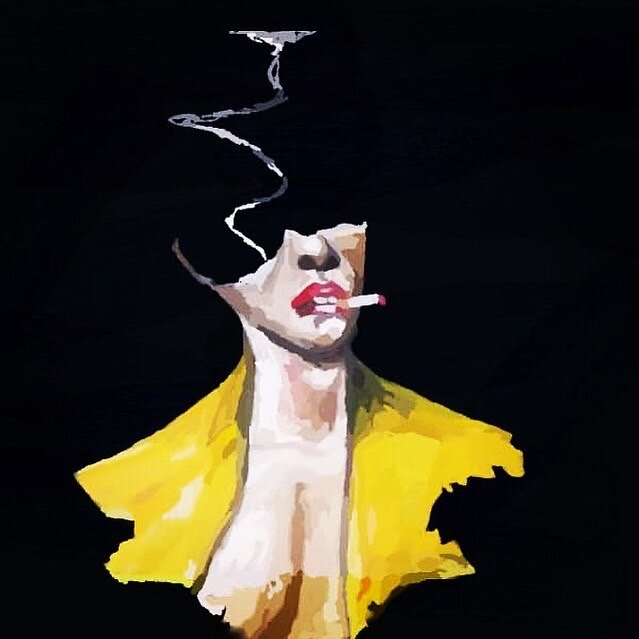
The cover art of Brymo’s album, Yellow
Let me start by saying I believe that Brymo’s Yellow is a great album.
Before you read on, note that I used the phrase, I believe. In my last draft of this review, I had included a mini disclaimer essay outlining my approach to reviews, but I realized that it didn’t need to be so long, especially since my approach is simple. I only write on how I feel. I don’t intend on providing history lessons. I don’t intend on starting conversations or debates (but I don’t discourage them either).
I just outline my thoughts on a certain subject or project, and I move on to the next topic of review. It isn’t supposed to be complicated or held to the light as fact, it is just my interpretation. That’s all.
Before Yellow, I rarely listened to Brymo. It wasn’t because I didn’t know him, but instead it was because he hasn’t infiltrated the US music market and when I lived in Lagos, I wasn’t a big enough fan to carry him here with me. I am glad that Yellow reconnected me with his music and introduced me to the amazing songstress, Lindsey Abudei.
Yellow also reminded me that I have the freedom to deviate completely from what a Nigerian creative is believed to be. A lot of times, the type of African music consumed in the US tends to be part of the same crop of club oriented Afrobeats bangers. This point isn’t intended to play into the ‘intellectual’ versus ‘cookie-cutter’ debate, but I do think it is important to point out that there is a type of Nigerian music that is promoted in the West. It is also important to note that the emphasis on Afrobeats creates the impression that Nigerian music can only be consumed in one form, hence encouraging more artistes to delve into the same genre.
Brymo is not one of those artistes. My first draft of this review started with the sentence:
Brymo’s Yellow is Brymo’s.
That was it, and even though it seems tautological, I was trying to emphasize the fact that Yellow is incredibly authentic to Brymo’s voice and it is very original (i.e.: not like any other artistes I have listened to in the past, Nigerian or otherwise).
Dami Ajayi described Brymo’s genre as Afro-Soul and even though I have an inclination to subscribe to such a classification, my aversion to categorization does not allow me to. Brymo’s music does not need to be slotted into a grouping of music because he does not (I assume) create with a genre in mind.
He does have common themes: love, longing, government corruption, injustice and he very much explored them in this album.
Yellow is divided into three sections based on the language the constituent songs were performed in, namely: English (Side A), Pidgin (Side B) and Yoruba/Igbo (Side C).
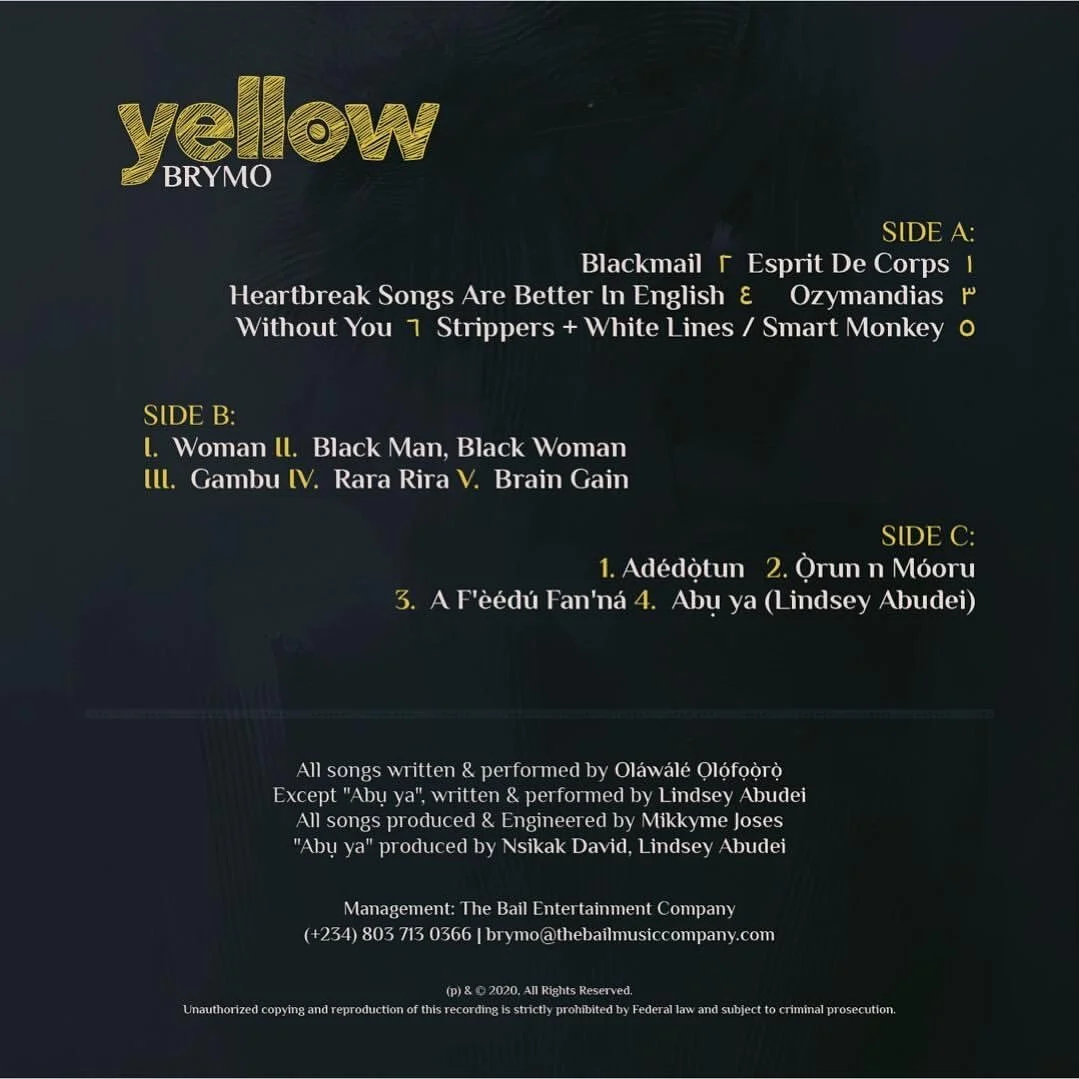
The Yellow album track list
Side A
Esprit de Corps ١
Esprit de Corps starts the album off. It features a prominent ‘itch’ rhyming scheme. At first, it made no sense to me, but after learning the meaning of the phrase esprit de corps, its role on the album became clear. It is a song that addresses the feeling of morale, corruption and greed creates in what I assume to be the Nigerian political elite.
‘Esprit de Corps, they are all in it together, blackmailing each other again; Esprit de Corps, and it fuels the disorder, blackmailing each other again.’
Blackmail ٢
At first, I thought Blackmail was the same song as Esprit de Corps because of the heavy use of the word blackmail, but when I finally associated melodies with track listings, the difference became obvious.
Blackmail seems to be sung to a lover, a lover that is trying to manipulate the singer into a compromising position. One of my favorite things about the song happens around the 2:15 minute mark. For about ten seconds, the drums lag behind Brymo’s vocals and it creates a disorienting effect. A part of me wonders if that was a deliberate decision or if I just imagined it, so please let me know if you hear it too in the comments.
Ozymandias ٣
My first impression of Ozymandias was ‘what the hell does this mean?’ I assumed it was gibberish, so I was shocked to find out it was a somewhat famous pair of sonnets composed in the 19th century in honor of a long forgotten Egyptian King called Ozymandias in Greek. Brymo’s song elaborates on history, pride and change.
‘History forgets all, Ozymandias; … hubris destroys us, Ozymandias’
Heartbreak Songs Are Better in English ٤
Heartbreak Songs Are Better in English was my favorite song the first time I listened to the album. It reminds me of a song like Nicki Minaj’s The Night is Still Young, not because of content but solely because of its pop vibes.
The title tells us all we need to know about the song, but one thing that isn’t immediately obvious is how poetic it is.
‘I was a bullet, you were a trigger, the universe pulled the shot’
Strippers + White Lines / Smart Monkey ٥
Strippers + White Lines / Smart Monkey is Brymo’s lead single. It is also the only song with a music video. At first, I didn’t understand why he made that decision, but now, after listening to the whole album at least twenty times, I can tell that it holds a special place in his heart. When he performs the ‘Oh, what a night’ section, I am always taken aback by the emotion. Despite this, I would have chosen a different song as the single.
Without You ٦
Without You just reminds me of how beautiful Brymo’s voice is. He has such a distinctive baritone and he definitely plays into his strengths.
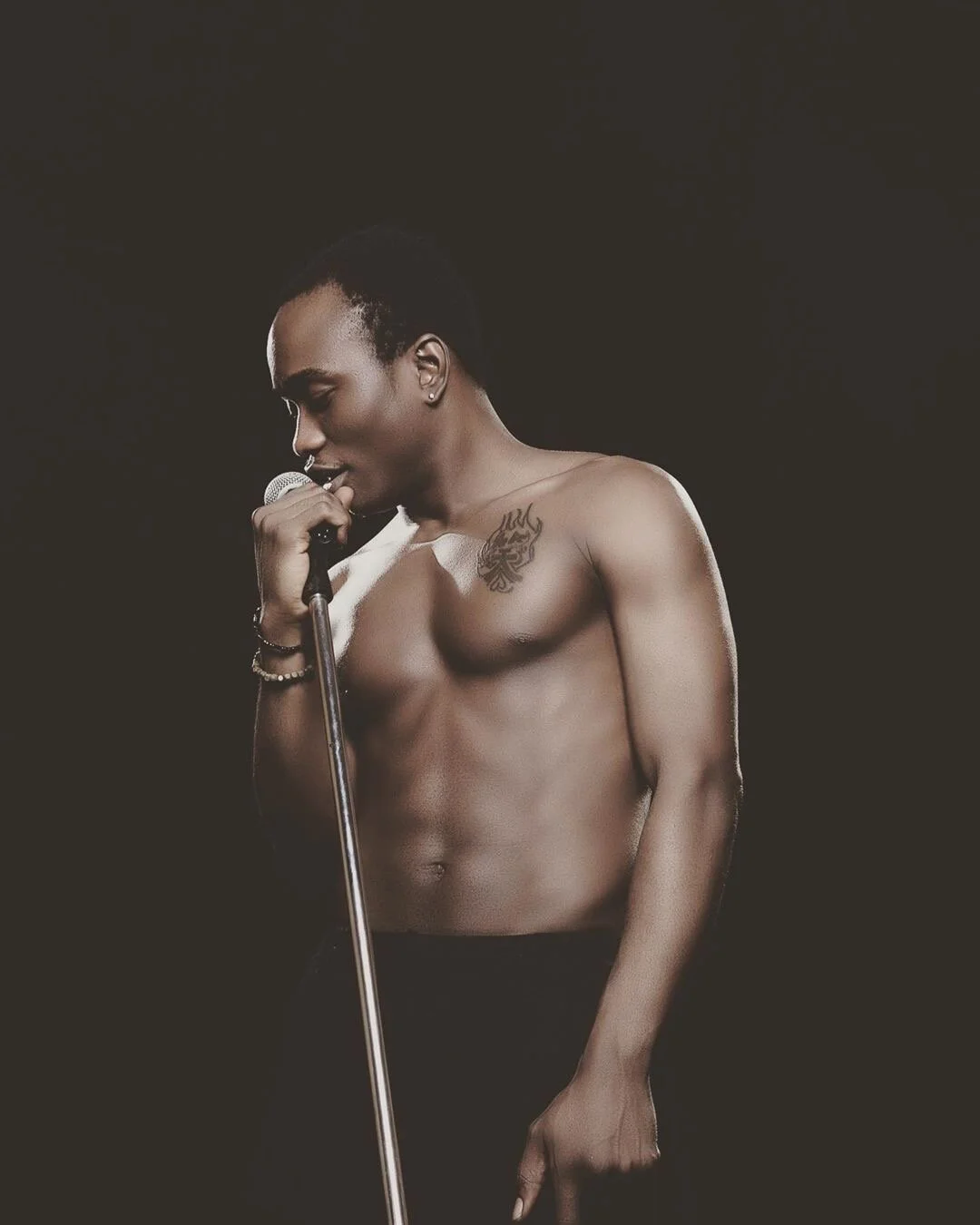
A photo of Brymo, source Instagram
Side B
I. Woman
Woman is the first song on the album sung in Pidgin and it definitely demarcates a change in energy. To be completely honest, I’m not a big fan of the song, but this is more reflective of my personal ideology. I just don’t like when gender is highlighted in ways that could seem prescriptive. I know that there is no monolithic experience, especially when it relates to gender, so it is hard for me to relate to this song.
II. Black Man, Black Woman
I have the same problem with Black Man, Black Woman. It assigns roles to men and women, and it even states that women make the rules we follow in society. I, obviously, find this troubling because it continues a tradition of gaslighting women into believing that the misogyny they suffer is of their design.
With this in mind, I would say that it reminds me of Lauryn Hill’s Doo Wop (That Thing). They are not stylistically similar, but they both explore the roles of men and women in society.
III. Gambu
I like Gambu. It reminds me of a genre of Latin American music. It has been described as a pop-infused soul and blues track and I am not completely sure if I agree. I can’t really pinpoint a genre, but every time I play it, it makes me want to dance the Salsa.
IV. Rara Rira
Rara Rira seems to be the only song on the album that could be considered marginally mainstream. It could definitely be a club banger if it needed to be. Apart from its danceability, Rara Rira contains a message that I personally live by:
‘… life is too short to worry too much and wait for God to come …’
V. Brain Gain
Brain Gain is an interesting song. Most migration stories center around the narrative of the folks (like me) that left their country and found hell or heaven in a new country. We don’t really hear the story of the folks that chose to stay. Songs like Brain Gain complicate the immigrant narrative because it highlights the folks that, despite having the means to leave, choose not to. In fact, Brain Gain goes further to say that we don’t need more emigration (i.e. brain drain), but instead we need repatriation (i.e. brain gain).
‘… some people stay through the wear and tear, na how you go know if you real I swear …’
Side C
1. Adédọ̀tun
Adédọ̀tun is one of my favorite songs on the album. I don’t understand a word sang, but his vocals were amazing, and it really reminds me of traditional Yoruba music. I could see the Yoruba aunties that lived in near my grandpa’s block and flats singing and dancing to this song unprovoked.
2. Ọ̀run n Móoru
Again, this song is in Yoruba, so my understanding of its lyrical content is severely limited. When one listens to a song in a different language, one is forced to pay attention to the emotion, the melody, the quality of the voice. Ọ̀run n Móoru is a sweet ballad that I wish I could translate.
3. A F'èédú Fan'ná
A F'èédú Fan'ná also reminds me of folk Yoruba music. When I listen to this song, I picture a group of women singing in a circle while clapping and cheering on the person dancing in the center. In this vision, the women rotate in and out of the circle at regular intervals all while dancing a traditional dance like Bata Bata.
![Vasilis Chukwunonso Onwuaduegbo (2020). n’ihunaya [Acrylic on 15 in x 11 in paper]. Painted in Harlem, U.S.A.](https://images.squarespace-cdn.com/content/v1/59245e906a4963afbcca13e7/1586751536859-OS5BS2TVE2LRVUKVKBET/IMG_1977-2.jpg)
Vasilis Chukwunonso Onwuaduegbo (2020). n’ihunaya [Acrylic on 15 in x 11 in paper]. Painted in Harlem, U.S.A.
4. Abụ Ya
Abụ Ya is my favorite song on this album. I was playing this song when I wrote and turned in my resignation for a job that I had been struggling with for a while. Lindsey Abudei can SING! My gosh, her voice. At one point while listening to the song, I posted it on my Instagram story with the caption: Oh. My. God. Even now, that’s the best description. It is the only song in Igbo, but given Brymo’s Yoruba heritage, it is completely unexpected and extraordinary. The song reminds me of Igbo gospel especially when Lindsey sings, ‘Na ebi n'ịhụnanya, E melem unu’. I love it so much that I named this review after it and I also made a painting.
This is it, folks. After fifteen beautiful songs, we have reached the end. Please tell me what you think.
1. Are you going to listen to the album, or have you already listened?
2. What do you think of it?
3. Did you like this review?
4. What did you like or not like about this?
Please share your thoughts below.